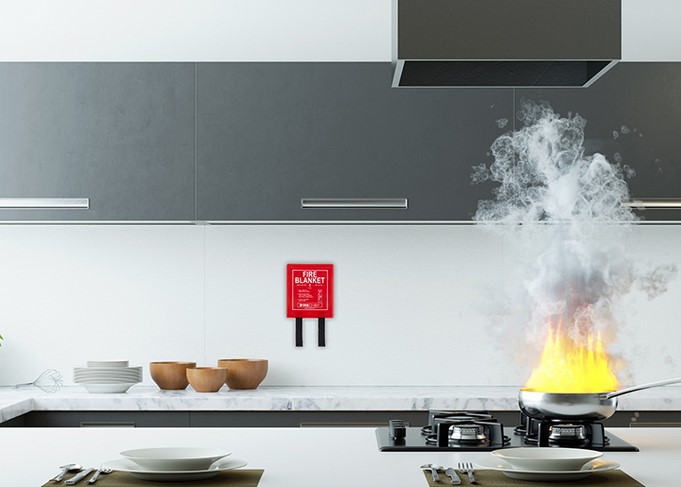
It happens in less than five seconds. You’re searing a steak or frying up some chicken, the oil gets a fraction too hot, and suddenly a violent, two-foot pillar of flame erupts from your skillet. Your natural, lizard-brain instinct is to grab the pan and run to the sink, or throw a glass of water directly onto the flame. But in my ten-plus years dealing with residential structural damage, I’ve seen that exact reaction turn a minor stovetop flare-up into a catastrophic, whole-house structural fire.
Water hitting boiling, burning oil instantly vaporizes into steam, expanding exponentially and carrying microscopic droplets of burning grease directly into your face, clothing, and ceiling drywall.
When establishing your home’s emergency safety infrastructure, you need a tool designed specifically to fight these specialized kitchen hazards. While traditional red fire extinguishers are great, they are often bulky, confusing to operate under panic, and leave behind a highly toxic, corrosive chemical residue that can ruin your expensive appliances. That is why I tell every single client that a high-quality kitchen fire blanket is their absolute first line of defense.
The Physics of Combustion: Why Suffocation Beats Suppression
To understand why this safety tool is so effective, we have to look at the fundamental chemistry of fire, often referred to in safety niches as the fire tetrahedron.
Breaking the Chain Reaction
A fire cannot exist without three core components working together in perfect balance: heat, fuel, and oxygen. If you remove just one of these pillars, the chemical chain reaction collapses instantly.
Think of a burning frying pan like a tiny, aggressive engine. Traditional water-based suppression tries to cool the heat pillar, but with oil fires, it fails spectacularly. A kitchen fire blanket, however, cuts off the oxygen supply completely. It acts like a giant, impenetrable physical lid that starves the flame of the air it desperately needs to breathe, suffocating the hazard within seconds without spreading the burning fuel across your countertops.
Material Science: The Fiber Mechanics
A proper fire-retardant blanket isn’t just a thick piece of wool or canvas. It is an engineered safety shield woven from highly specialized fiberglass fabric.
-
The Core Layer: Woven glass filaments that can withstand continuous, extreme thermal thresholds of up to 1,022°F (550°C) without melting, catching fire, or transferring structural heat to your hands.
-
The Coating Layer: High-end modern blankets are frequently treated with a thin coating of silicone or polyurethane polymer. This specialized coating prevents microscopic glass shards from irritating your skin during handling and seals any tiny microscopic gaps in the weave, ensuring zero air penetration.
Strategic Deployment: Where and How to Mount Your Safety Hub
Having a piece of emergency hardware buried deep inside a cluttered junk drawer or stashed under a mountain of plastic bags beneath the kitchen sink is exactly the same as not owning one at all. When a grease fire breaks out, panic sets in, and your cognitive processing drops; you need visual accessibility.
The 3-Second Accessibility Rule
In my professional field assessments, I look for what we call “low-friction deployment zones.” Your kitchen fire blanket should be mounted visibly on a wall or inside a cabinet door along your primary exit path, roughly 5 to 6 feet away from the stove.
Never mount it directly above or behind the cooktop. If the stove is actively engulfed in rolling flames, you will not be able to reach across the fire zone to grab your safety equipment without sustaining severe thermal burns.
Step-by-Step Tactical Deployment: Operating a Fire Blanket Under Pressure
Operating a modern safety blanket is designed to be completely intuitive, but you should walk through the physical mechanics long before an actual emergency occurs. Here is the exact protocol taught by emergency response professionals.
Hidden Warnings and Professional Expert Advice
Not all safety equipment is created equal, and misunderstanding your tools can lead to devastating structural failures.
The Single-Use Trap
A kitchen fire blanket is strictly a single-use emergency device. Even if the blanket looks completely intact and unburnt after suffocating a small stovetop fire, the extreme heat exposure alters the molecular structure of the fiberglass filaments, making them brittle and highly porous. Once it has been deployed against an active hazard, wrap it in a plastic bag and dispose of it immediately—never repack it into the pouch.
💡 Expert Pro-Tip: The Human Wrap Strategy
One of the greatest logistical advantages of a fiberglass safety blanket over a mechanical fire extinguisher is its versatility in body protection. If a family member’s clothing catches fire near the stove, an extinguisher can cause severe chemical burns to their eyes and respiratory tract. A fire blanket can be instantly wrapped tightly around a person to smother clothing flames safely, or used as an insulated thermal wrap to shield yourself if you have to escape through a smoke-filled room.
Comparative Matrix: Fire Extinguisher vs. Fire Blanket
| Tactical Metric | Standard ABC Dry Chemical Extinguisher | Specialized Kitchen Fire Blanket |
| Primary Mechanism | Chemical interruption & suppression | Direct atmospheric oxygen suffocation |
| Post-Incident Cleanup | Severe (Corrosive powder coating everything) | Zero (Pick up the pan and wipe the counter) |
| Expiration/Maintenance | Requires annual pressure gauge checks | Infinite shelf-life until deployed |
| User Learning Curve | Moderate (PASS technique required) | Extremely Low (Pull tabs and lay flat) |
| Physical Footprint | Bulky, requires wall anchors or brackets | Ultra-slim, mounts easily inside cabinet doors |
Conclusion: Securing Your Home’s Most Dangerous Zone
True home improvement is about more than just matching your backsplash tiles to your countertops; it is about building a resilient, intelligent living space that protects the people inside it. Upgrading your emergency safety infrastructure by strategically mounting a kitchen fire blanket is one of the most low-cost, high-return investments you can make for your family’s physical security. It bridges the gap between helpless panic and calm, decisive hazard mitigation.
Have you mapped out your kitchen’s emergency exit path and safety tool locations lately? Is your current fire protection equipment accessible within three seconds, or is it buried behind old cleaning supplies? Let me know your current setup or drop your safety layout questions in the comments below—let’s make sure your cooking space stays completely safe!
