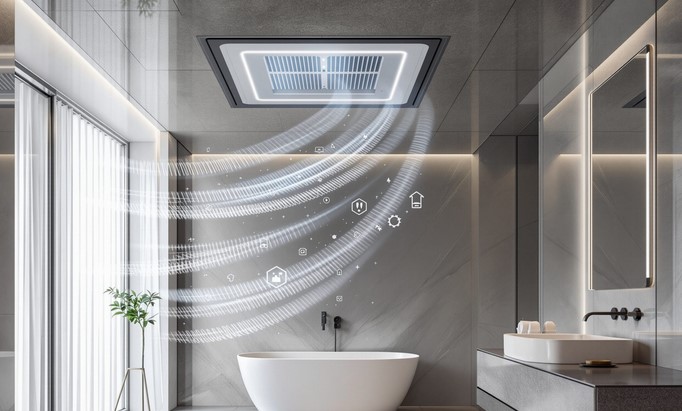
Step into almost any home built more than twenty years ago, and you’ll likely find a silent, hidden structural threat lurking right above the shower. I remember a gut renovation project I managed where the homeowner complained about a persistent “musty smell” that no amount of scented candles could fix. When we peeled back the ceiling drywall, my entire crew took a step back—the entire cavity was covered in thick, black toxic mold. The culprit wasn’t a leaking roof pipe; it was a cheap, improperly installed ventilation fan that had been venting moist air straight into the attic for over a decade.
In my ten-plus years as a home improvement expert, I’ve noticed that people spend thousands of dollars picking out the perfect marble tile or a luxury rainfall showerhead, yet they treat the bathroom exhaust fan as an afterthought. That is a massive mistake.
Your bathroom is essentially a high-humidity tropical ecosystem trapped inside a sealed box. Without a high-performance mechanical ventilation strategy, that daily steam from your shower turns into an aggressive solvent, slowly destroying your drywall, peeling your expensive wallpaper, rotting your wood framing, and severely degrading your indoor air quality.
The Physics of Humidity: Understanding Air Exchange Rate
To truly optimize your home’s air quality, you have to look past the aesthetic cover of the fan grille and focus on the math of air movement.
What on Earth is CFM?
When shopping for a bathroom exhaust fan, you will see a prominent rating labeled CFM, which stands for Cubic Feet per Minute. This metric measures the exact volume of air the fan motor can physically extract from the room and dump outside every sixty seconds.
Think of your bathroom like a muddy swimming pool that you need to completely drain and refill with fresh water. A fan with a CFM rating that is too low is like trying to drain that pool with a tiny straw—the moisture hangs around in the air for hours, condensing on cold surfaces. You need a mechanical “pump” powerful enough to completely cycle and replace the room’s air volume at least eight times per hour.
The Golden Rule of Sizing
Calculating the precise CFM requirement for your space is surprisingly simple. The standard rule of thumb established by the Home Ventilating Institute (HVI) is straightforward: You need 1 CFM of ventilation performance for every square foot of bathroom floor space.
-
A small 5ft x 8ft powder room (40 sq ft) requires a minimum 50 CFM fan.
-
A standard 8ft x 10ft master bathroom (80 sq ft) needs an 80 CFM fan.
-
Pro Insight: If your ceiling is higher than the standard 8 feet, or if you have a dedicated jetted whirlpool tub, you must scale up your target by an extra 20 to 30 CFM to account for the increased air volume and heavy steam production.
Technical Metrics That Matter: Sones and Static Pressure
Most homeowners buy a fan, install it, and then never turn it on because it sounds like a jet engine taking off inside their bathroom. This completely defeats the purpose of critical air quality management.
Deciphering the Sone Rating
A sone is the internationally recognized unit of loudness. Unlike decibels, which are purely logarithmic physics, sones measure how sound is actually perceived by the human ear.
-
4.0 Sones: Loud and irritating (similar to a noisy restaurant kitchen). Avoid these.
-
2.0 Sones: Normal conversation level. Acceptable for guest bathrooms.
-
1.0 Sone or less: Whisper-quiet (similar to a gentle rustling of leaves). This is the gold standard for master suites where you want a relaxing, spa-like environment.
The Battle Against Static Pressure
A fan motor doesn’t operate in a vacuum. It has to push heavy, humid air through a long, twisting maze of ductwork before it reaches the outside world. This resistance is called static pressure.
If your contractor used cheap, flexible ribbed foil ducting and bent it into sharp 90-degree angles, your high-performance 110 CFM fan might actually only be pushing 50 CFM of air. To maintain optimal efficiency, always insist on smooth-walled rigid aluminum ducting and keep the run as short and straight as possible.
Step-by-Step Selection and Installation Blueprint
If you are an intermediate DIYer looking to replace an old, dying unit or install a fresh system, your success relies on avoiding structural bottlenecks.
Professional Field Advice
After a decade of troubleshooting failed ventilation systems, I’ve uncovered a few hidden variables that can make or break your air quality strategy.
The “Air Lock” Bottleneck
An exhaust fan cannot push air out of a room unless fresh air can come in to replace it. If your bathroom door has an incredibly tight seal at the bottom against a thick plush rug, your fan will starve for air, creating a vacuum effect that ruins its efficiency. Ensure there is at least a 1/2-inch to 3/4-inch gap underneath your bathroom door to allow proper cross-ventilation makeup air to enter the space.
💡 Expert Pro-Tip: Ditch the Standard Toggle Switch
Most people flip the fan off the second they step out of the shower because they don’t want to forget about it and leave it running all day. However, mold-causing humidity lingers in the air for up to 20 minutes after you turn off the water. Replace your manual wall switch with a humidity-sensing smart switch or a digital countdown timer. The sensor will automatically run the fan until the room’s relative humidity drops back down to safe levels (below 50%), then shut itself off completely.
Performance Comparison: Ventilation Control Strategies
| Feature / Control Type | Standard Manual Toggle | Electronic Countdown Timer | Built-In Humidity Sensor |
| User Effort Required | High (Must remember to flip it off) | Low (Set it for 20 mins and walk away) | Zero (Completely automated) |
| Mold Prevention Efficiency | Poor (Usually turned off too early) | Good (Sufficient run time) | Excellent (Measures actual atmospheric moisture) |
| Energy Conservation | Low (Often left running for hours) | High (Guaranteed auto-shutoff) | Maximum (Only runs when absolutely necessary) |
| Ideal Application | Low-traffic powder rooms | Guest baths and kids’ rooms | Master suites and high-steam shower zones |
Conclusion: Take Control of Your Indoor Environment
Optimizing your home’s air quality management isn’t just about passing a home inspection; it’s about protecting your physical health and preserving your structural investment. By selecting a properly sized, whisper-quiet bathroom exhaust fan and ensuring it vents entirely outside the thermal envelope of your home, you eliminate the silent threat of structural moisture damage before it even has a chance to take root.
It’s an easily scannable upgrade that completely changes the comfort dynamic of your daily routine.
What does your current bathroom fan sound like when you flip it on? Does it clear the mirror fog within 10 minutes of your shower ending? Let me know your current setup dimensions or drop your troubleshooting questions in the comments below—let’s get your indoor air quality perfectly dialed in!
