Imagine turning on your shower, stepping into the warm stream, and being greeted by a subtle smell of swimming pool chlorine. Or waking up to stubborn white crust rings around your pristine bathroom fixtures just weeks after deep cleaning.
Over my ten-plus years in home improvement and residential plumbing retrofits, I’ve lost count of how many homeowners spend thousands of dollars on high-end kitchen sink purifiers, only to ignore the hundreds of gallons of raw, municipal water coursing through their water heaters, washing machines, and showerheads every single day.
Addressing water quality at a single tap is like puting a tiny air purifier in your bedroom while leaving all the windows open during a dust storm. True household water management starts where the main service line enters your home—and that is where a properly engineered whole house filter system changes everything.
Why Single-Point Filters Miss the Bigger Picture
Early in my career, I got a call from a client who was frustrated that her brand-new high-efficiency washing machine had developed a foul odor and failed pump within 14 months. When I dismantled the inlet valves, they were caked in fine sediment, rust flakes, and mineral scale.
She had a top-of-the-line drinking water pitcher in her fridge, but her major appliances were swallowing hundreds of gallons of unfiltered water weekly.
                       INCOMING MAIN WATER LINE
                                  |
                                  v
                    +---------------------------+
                    |    WHOLE HOUSE FILTER     |  <-- Treats 100% of incoming water
                    +---------------------------+
                                  |
         +------------------------+------------------------+
         |                        |                        |
         v                        v                        v
  [ Kitchen Taps ]       [ Showers & Baths ]     [ Appliances & Boilers ]
 (Clean Drinking)        (No Chlorine Vapors)     (Protected Heating Elements)
Point-of-use (POU) filters treat water at the very last second before consumption. In contrast, a whole house filter acts as a centralized boundary defense system, treating 100% of the water entering your home network before it branches off into your hot water tank, bathrooms, and laundry facilities.
The Technical Anatomy of a Multi-Stage Whole House Filter
To understand how these systems protect your infrastructure, think of your plumbing network like a modern freeway system. A whole house filter acts as a toll plaza, filtering out heavy freight and hazardous debris before traffic spreads to city streets.
A high-performing system typically relies on a multi-stage process:
1. Sediment Pre-Filtration (The Bouncer)
-
Target: Sand, silt, rust particles, and suspended solids.
-
Mechanism: Spun polypropylene or pleated cartridges rated between 5 to 20 microns.
-
Role: Captures large debris to prevent clogging sensitive downstream media and valve seats.
2. Activated Carbon Media (The Chemical Absorber)
-
Target: Chlorine, chloramines, volatile organic compounds (VOCs), and offensive odors.
-
Mechanism: Catalytic or granular activated carbon (GAC) derived from coconut shells.
-
Role: Uses chemical adsorption to bond with synthetic compounds and gas molecules.
3. Specialty Post-Filtration or Conditioning (The Polisher)
-
Target: Heavy metals, micro-particulates, or scale-forming hard minerals.
-
Mechanism: KDF media beds, sub-micron post-filters, or salt-free descalers.
-
Role: Provides final conditioning to ensure water chemistry remains gentle on copper lines and PEX fittings.
Comparing Whole House Filter Configurations
Choosing the right filtration approach depends heavily on your incoming flow rate (GPM), space availability, and source water characteristics.
| Filter Type | Primary Focus | Maintenance Interval | Best Suited For |
| Big Blue Cartridge Systems | Sediment, rust, taste/odor | Every 3–6 months | Small to medium homes, budget-friendly setups |
| Heavy-Duty Media Tank Systems | High-volume chlorine, VOCs, long-term filtration | Every 5–10 years (media replacement) | Large homes, long-term property investment |
| Well Water Specialty Systems | Iron, manganese, hydrogen sulfide (rotten egg odor) | Varies (backwashing cycles) | Private well systems, rural properties |
Step-by-Step Installation Planning
Before investing in a whole house filter, walk through these structural considerations to avoid common retrofitting headaches.
Step 1: Calculate Your Required Flow Rate (GPM)
Never size a filter based on the size of your pipe line alone. Calculate your peak water usage by totaling the appliances that might run simultaneously:
-
Showerhead: 2.0–2.5 GPM
-
Washing Machine: 3.0–4.0 GPM
-
Kitchen Sink: 1.5–2.0 GPM
If your home demands 12 GPM at peak capacity, buying an 8 GPM filter will create an annoying pressure drop across all your fixtures.
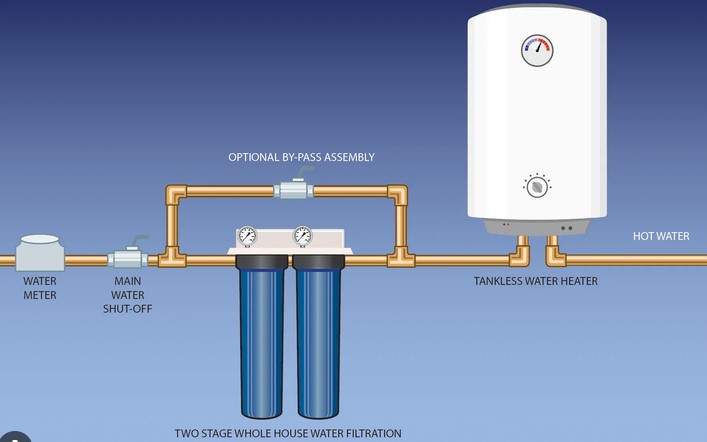
Step 2: Locate the Main Shut-off and By-Pass Loop
Mount the whole house filter downstream of your main shut-off valve, but upstream of your water heater and indoor distribution tees.
 [ Main Supply ] --> [ Shut-Off ] --> [ Pre-Filter ] --> [ Main Filter ] --> [ Water Heater ]
                                  |                                   |
                                  +-------->[ Bypass Valve ]----------+
Always install a three-valve bypass loop during setup. This allows you to service the filter or replace cartridges without shutting off water to the entire household.
Expert Advice: Pro Tips and Hidden Pitfalls
💡 Pro Tip: Pressure Gauge Bookends
Install dual pressure gauges—one immediately before the whole house filter inlet and one right after the outlet. When the pressure differential between the two gauges exceeds 10–15 PSI, you know it’s time to swap cartridges, eliminating any guesswork.
⚠️ Hidden Pitfall: Grounding Wire Interruption
Older homes often use metallic copper water pipes as the primary electrical grounding path for the main panel. Cutting out a section of metal pipe to install a plastic filter housing severs this electrical ground. Always clamp a heavy-gauge copper jumper wire across the filter gap to maintain electrical safety.
Frequently Asked Questions
Does a whole house filter soften hard water?
No. Standard filtration removes physical particles, chemicals, and heavy metals, but it does not remove dissolved calcium and magnesium ions. To stop hard water scale buildup, pair your filter with a dedicated water softener or a salt-free descaler.
How much water pressure loss should I expect?
A properly sized system will cause a negligible drop of 1 to 3 PSI when fresh. Significant pressure drops indicate an undersized system or a clogged cartridge that needs servicing.
Take Control of Your Home’s Water Ecosystem
Scaling purity across your entire living space isn’t a luxury—it’s a fundamental investment in your plumbing infrastructure, your health, and your household appliances. Installing a robust whole house filter stops contaminants at your boundary line, ensuring every drop that flows through your home is clean and reliable.
Have you tested your home’s water quality recently, or are you noticing signs of chlorine and sediment in your fixtures? Drop a comment below with your setup details or questions, and let’s discuss the ideal filtration strategy for your home!