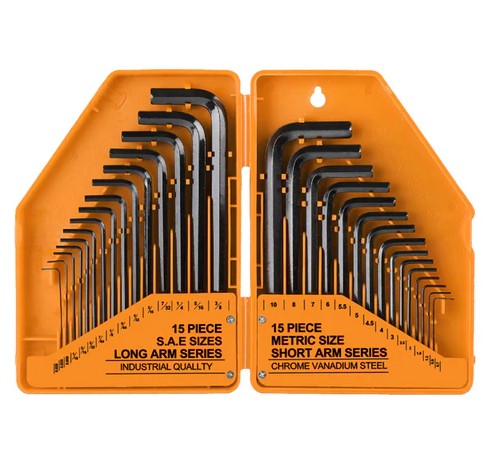
You’re halfway through assembling a high-end ergonomic chair or fixing a loose faucet handle when you hit a literal wall. You reach for your standard screwdriver, but it slides right off the fastener. You try a pair of pliers, but you only succeed in scratching the finish. There, staring back at you, is a tiny, six-sided hexagonal hole—the “gatekeeper” of modern furniture and machinery. Without a high-quality Hex Key Set, your project doesn’t just slow down; it stops dead.
In my ten years of managing property renovations and maintaining complex HVAC systems, I’ve learned that the smallest tools often carry the heaviest responsibility. I’ve seen $5,000 commercial boilers rendered useless because a technician stripped a $2 set screw using a cheap, rounded-off wrench. A Hex Key Set (often called Allen wrenches) is the bridge between a “handyman” and a “precision technician.” Once I moved away from the flimsy freebies found in flat-pack boxes and invested in a professional-grade set, my ability to perform systematic, damage-free repairs skyrocketed.
The Physics of the Hex: Why Six Sides Matter
To understand the value of a Hex Key Set, we have to look at the engineering of the fastener itself. Unlike a Phillips head screw, which is designed to “cam out” (the screwdriver slips out to prevent over-tightening), a hex bolt is designed for maximum torque transfer.
Think of a hex key like a geared transmission. Because the tool makes contact with the fastener on six distinct flat surfaces, the pressure is distributed evenly. This allows you to apply significantly more force without slipping. However, this precision is a double-edged sword. Because the tolerances are so tight, using a tool that is even 0.1mm off—or made of soft, inferior metal—will “round out” the internal corners of the bolt, turning a 10-second task into a two-hour extraction nightmare.
Choosing Your Weapon: SAE vs. Metric vs. Torx
When you walk into a hardware store, the variety of sets can be overwhelming. For a beginner or intermediate DIYer, the first rule is simple: Never “guesstimate” your sizing.
-
Metric vs. SAE (Fractional): In the world of home improvement, these are not interchangeable. A 5mm hex key might feel like it fits a 3/16-inch bolt, but the microscopic gap will strip the fastener the moment you apply torque. I always carry a “Double-Up” Hex Key Set that includes both a blue-coded (Metric) and red-coded (SAE) holder.
-
Torx (Star Bits): While they look similar, Torx fasteners have six points rather than six flats. Using a hex key in a Torx bolt is the fastest way to ruin your day.
-
Material Grade: Look for S2 Tool Steel or Chrome Vanadium (Cr-V). These materials are heat-treated to resist twisting (torsion) and rounding. If the set costs less than a cup of coffee, leave it on the shelf.
Professional Techniques for Systematic Repairs
In my decade of practice, I’ve developed a systematic approach to using a Hex Key Set that ensures the tool does the work, not your muscles.
1. The L-Shape Leverage Play
The classic L-shaped hex key is a masterpiece of simple engineering. Use the short arm for high-torque applications (breaking a stubborn bolt loose) and the long arm for speed and reaching into deep recesses.
2. The Ball-End Advantage
Many professional Hex Key Set options feature a “ball-end” on the long arm. This allows you to turn the fastener at an angle of up to 25 degrees. This is a lifesaver when you’re working inside a tight cabinet or behind a radiator where a straight approach is impossible. Note: Never use the ball-end to break a bolt loose or for the final “cinch,” as the reduced surface area can snap the tip.
3. The “T-Handle” Evolution
If you are performing repetitive maintenance—like tightening every chair in a restaurant or adjusting a series of machinery pulleys—invest in a T-handle Hex Key Set. The ergonomic grip allows for a balanced, spinning motion that reduces wrist fatigue and provides a much more tactile “feel” for the thread tension.
Technical Data: Torque and Tolerance
For the intermediate user, precision is about understanding the limit of the metal. Most M6 hex bolts (common in furniture) have a recommended torque of roughly 10-12 Nm.
A high-quality Hex Key Set is engineered with a specific “yield point.” I’ve had moments where a hex key began to flex slightly under my hand—this is the tool “communicating” with you. It’s telling you that you’ve reached the maximum tension before either the bolt snaps or the tool deforms. Cheap tools don’t flex; they just shatter or strip the bolt.
Tips Pro: The “Zero-Tolerance” Clean
Before you even insert your hex key, take a small pick or a blast of compressed air to clean the fastener’s head. Over years, grease, paint, or dust can build up in the bottom of the hex hole. If your Hex Key Set doesn’t sit 100% deep into the fastener, you are only making contact with the top 2mm of the metal, which is a guaranteed recipe for stripping the head.
The Systematic Maintenance Checklist
If you want to move from “fixing things when they break” to “systematic maintenance,” keep this checklist in mind for your Hex Key Set:
-
Wipe it down: After working near plumbing or oily machinery, wipe your keys with a rag. Moisture trapped in the holder causes rust, which increases the size of the tool and ruins the precision fit.
-
Check for “Rounding”: Periodically inspect your most-used keys (usually the 4mm, 5mm, and 6mm). If the edges look shiny and curved, use a bench grinder to carefully trim 2mm off the tip to expose fresh, sharp edges.
-
Organized Storage: If you lose the 3mm key from your set, the whole set is effectively broken. Use a holder that “locks” the keys in place so they don’t slide out in your tool bag.
Precision engineering isn’t just for aerospace scientists; it’s for the homeowner who wants their repairs to last a lifetime. A professional-grade Hex Key Set is a one-time investment that protects your furniture, your appliances, and your sanity. By respecting the six-sided geometry and using the right material and technique, you move from frustrating “hack” jobs to systematic, expert-level maintenance.
The next time you see that hexagonal bolt, don’t reach for the pliers. Reach for the right key and feel the satisfying “click” of a perfect fit.
What’s the most frustrating stripped bolt you’ve ever dealt with? Did it happen because of a cheap tool or just bad luck? Drop a comment below—I’d love to help you figure out the best extraction method or recommend a specific Hex Key Set that can handle your toughest home projects!
Would you like me to dive deeper into the differences between T-handle and Folding sets, or perhaps explain how to use a “cheater bar” safely for extra leverage?
