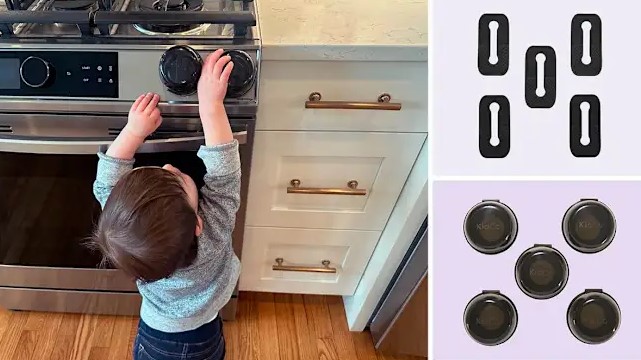
Imagine you’re in the middle of a conference call in your home office when a faint, rotten-egg smell begins to drift under the door. Your heart sinks. You rush to the kitchen to find your three-year-old proudly “driving” the stove like a race car, having clicked the gas burner into the ‘open’ position without a flame. According to the National Fire Protection Association, equipment turn-on is a leading cause of home fires, and in my ten years of inspecting and renovating homes, I’ve seen how a five-second lapse in supervision can turn a kitchen into a high-risk zone.
In the industry, we talk a lot about “Hardening the Target”—a fancy way of saying we make dangerous things harder to access. While we often focus on expensive security systems or structural repairs, some of the most critical safety upgrades cost less than a pizza. The stove knob covers are the unsung heroes of kitchen “logistics.” I’ve installed high-end smart stoves that cost thousands, yet I still advise my clients that a simple physical barrier is often the most reliable line of defense against unauthorized use.
The Invisible Threat: Why Kitchen Knobs are a Liability
Most people assume their stove is safe because they taught their kids “not to touch.” But in my experience, the kitchen is a magnet for curiosity. Whether it’s a toddler practicing their motor skills or a confused elderly family member with dementia, the ease with which a modern stove knob turns is a major design flaw in terms of facility safety.
Think of a stove knob like a “deadman’s switch” on a train, but in reverse. On a train, you have to hold it to keep things moving; on a stove, one accidental lean while reaching for a spice rack can initiate a gas leak or a red-hot electric coil. A stove knob covers acts as a lockout/tagout (LOTO) system for your home, ensuring that the “ignition” phase of the appliance remains under the total control of a responsible operator.
Anatomy of a High-Quality Stove Knob Cover
When you’re shopping for safety gear, don’t just grab the first plastic bubble you see. In a decade of home improvement, I’ve replaced dozens of cheap covers that melted or snapped within a month. If the material can’t handle the heat—literally—it’s a safety hazard in itself.
Material Science: Heat Resistance
You want a cover made from high-heat resistant polycarbonate. This isn’t your standard plastic bottle material. Polycarbonate is used in bulletproof glass and riot shields; it can withstand the ambient heat of a 450°F oven without warping.
The Mechanism of Action
A professional-grade stove knob covers usually features a hinged lid with a dual-action latch.
-
The “Child-Proof” Logic: It requires a level of hand-eye coordination and finger strength that toddlers haven’t developed yet.
-
The “Adult-Friendly” Design: It should allow you to flip the lid open with one hand while holding a frying pan in the other. If it’s too hard for you to use, you’ll eventually stop using it, and that’s when accidents happen.
Installation Logistics: Ensuring a Universal Fit
I’ve had clients call me frustrated because their covers didn’t fit their “professional-grade” ranges. Before you buy, you need to conduct a quick audit of your stove’s layout.
-
Clearance Check: Measure the distance between the center of one knob and the next. Some “oversized” covers will overlap, preventing them from closing properly.
-
Stem Depth: Ensure the “neck” of the knob isn’t too thick for the cover’s base.
-
Removable vs. Non-Removable: Most stove knob covers require you to pull the knob off, slide the base on, and then push the knob back on. If your knobs are permanently fixed (rare, but it happens), you’ll need a “clamshell” style that snaps around the existing hardware.
Beyond Toddlers: Specialized Safety Use Cases
While childproofing is the primary market, I’ve implemented these protocols in various environments that many homeowners don’t consider.
Aging-in-Place and Dementia Care
As we age, cognitive decline can lead to “forgetful cooking.” I’ve worked on several ADA-compliant renovations where we used stove knob covers to prevent accidental activation by seniors. It provides peace of mind for caregivers, acting as a physical reminder that the stove is a “restricted zone.”
The “Curious Pet” Factor
You’d be surprised how many “unexplained” fires are started by large dogs jumping up to reach leftovers on the counter. Their paws can easily snag a front-mounted knob. In my book, if you have a dog that can reach the counter, you have a stove that needs a cover.
Technical Maintenance of Safety Barriers
Tips Pro: The Degreasing Protocol
In a busy kitchen, aerosolized grease (from frying) will eventually coat your stove knob covers. This creates a sticky residue that can jam the latch or make the clear plastic cloudy. Don’t use abrasive scrubbers; they’ll scratch the polycarbonate. Soak them in a mix of warm water and a heavy-duty dish soap once a month to keep the “click” mechanism smooth and reliable.
The “False Security” Trap
Never assume a cover makes a stove 100% safe. I always tell my clients: the cover is a delay tactic, not a vault. Use it in conjunction with a functioning carbon monoxide detector and a natural gas alarm. If a child sees you open the cover enough times, they might eventually mimic the movement. Constant vigilance is the true safety protocol.
Why Physical Barriers Outperform Smart Alarms
We live in an age of “smart homes,” and I love a good tech solution. However, when it comes to preventing a gas leak, a physical stove knob covers beats a smartphone notification every time.
An app tells you that the stove is on; a cover ensures the stove never gets turned on in the first place. It’s the difference between a smoke detector (which reacts to a fire) and a sprinkler system (yang memadamkan api) or, better yet, a fire-proof safe. In the hierarchy of safety, prevention is always superior to detection.
Format Scannable: Quick Setup Checklist
-
Audit your knobs: Are they front-mount or top-mount?
-
Check the material: Is it labeled “Heat Resistant Polycarbonate”?
-
Test the latch: Can you open it with one hand?
-
Clean the surface: Ensure the stove face is free of grease before installing the base plates.
-
Check for “Knob Play”: Ensure the cover doesn’t press against the knob, which could accidentally engage the igniter.
Conclusion: A Small Investment for Absolute Peace of Mind
Home improvement isn’t always about the “wow” factor of a new backsplash or a marble island. Often, the most profound improvements are the ones that keep your family safe while you sleep. Installing stove knob covers is a low-cost, high-impact safety protocol that manages the “unauthorized use” of your most dangerous household appliance.
It’s about taking control of your environment and eliminating “what if” scenarios before they become “what now” emergencies.
Does your kitchen have a “weak point” when it comes to safety? Have you ever walked into the room to find a burner left on, or a knob turned just slightly? Take a look at your stove today—if those knobs are exposed, you’re one “race car” game away from a disaster. If you’re unsure which brand fits your specific model of range, drop a comment below. I’ve seen nearly every stove configuration on the market and I’m happy to help you “harden your target!”
