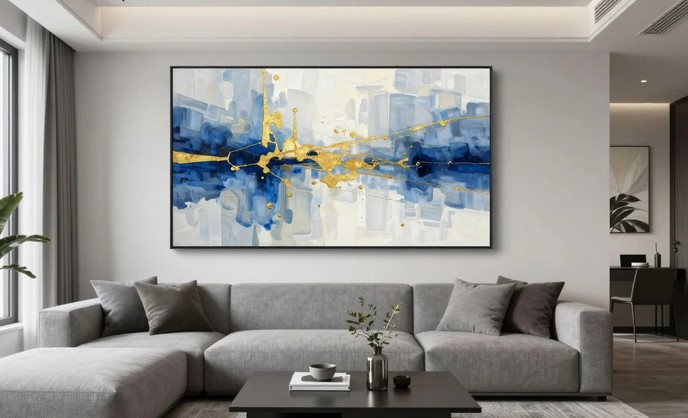
Walk into almost any home office or corporate workspace, and you will likely notice the exact same scene: ergonomic chairs, sleek desks, expensive monitors, and vast expanses of completely dead, blank drywall.
In my ten-plus years as a home improvement specialist, I’ve watched clients drop thousands of dollars on high-end office furniture only to wonder why their workspace still feels clinical, sterile, or utterly uninspiring.
A workspace without visual texture is like a luxury car without an interior headliner—it functions fine, but the acoustic resonance and felt atmosphere are completely stripped away. Integrating carefully curated canvas wall art into a professional room isn’t just about decorative flair; it’s a strategic architectural move that balances spatial acoustics, visual focal points, and psychological focus.
The Spatial Impact of Canvas Wall Art in Modern Workspaces
Early in my career, I was tasked with redesigning a home studio for an independent consultant whose main complaint was client fatigue during video calls. The room was well-lit, but the background wall behind his chair looked cold and washed out on camera.
We replaced the bare drywall with two large-scale pieces of gallery-wrapped canvas wall art featuring subtle, abstract geometric patterns. The shift was immediate. Not only did the camera background gain depth, but the natural texture of woven canvas softened the harsh echoes bouncing off his hardwood floors.
+-------------------------------------------------------------------+
|                       THE VISUAL ACCENT WALL                      |
|                                                                   |
|   +-----------------------+               +-------------------+   |
|   |                       |               |                   |   |
|   |   CANVAS WALL ART     |               |  CANVAS WALL ART  |   |
|   |  (Acoustic Softener)  |               | (Visual Anchor)   |   |
|   |                       |               |                   |   |
|   +-----------------------+               +-------------------+   |
|                                                                   |
+-------------------------------------------------------------------+
|                           MAIN DESK SETUP                         |
+-------------------------------------------------------------------+
Unlike flat paper prints under glare-prone glass, cotton-poly canvas stretched over solid wooden stretcher bars absorbs light instead of bouncing it back into your eyes. This glare-free finish makes canvas wall art exceptionally practical for high-lit professional spaces and home offices with multiple monitor setups.
Technical Considerations: Choosing the Right Canvas Specs
Not all decorative wall pieces are built the same. When picking canvas for professional spaces, you need to look past the surface design and evaluate its physical construction.
1. Fabric Blend: Cotton vs. Polyester
-
100% Cotton Canvas: Offers a natural, highly textured weave with classic archival appeal. Best suited for fine-art reproductions and matte abstract designs.
-
Polyester/Cotton Blends: Provides superior color vibrancy, tighter weave patterns, and high moisture resistance. Ideal for crisp photography prints and high-humidity climates.
2. Frame Depth and Stretcher Bars
Standard decorative canvases use thin 0,75-inch stretcher bars. However, for a truly professional gallery look that pops off the wall without requiring a heavy external frame, always opt for 1,5-inch gallery wraps. Solid pine or kiln-dried fir bars resist warping over time due to seasonal humidity changes.
3. Print Technology and Protective Coatings
Ensure the print uses archival pigment inks (such as giclée printing) combined with a UV-resistant matte varnish. This prevents color fading from direct sunlight exposure while allowing you to wipe away dust with a dry microfiber cloth without smudging the artwork.
Comparing Canvas Framing and Display Styles
Depending on your room’s architectural aesthetic, how you frame and position your canvas wall art drastically alters its presence.
| Frame / Wrap Style | Profile Depth | Aesthetic Character | Best Space Application |
| Standard Gallery Wrap | 1,5 Inches | Clean, frameless, modern | Minimalist home offices, tech setups |
| Floating Frame | 1,75–2,0 Inches | Elevated, high-end, structured | Executive suites, formal conference nooks |
| Multi-Panel Triptych | 0,75–1,5 Inches | Dynamic, expansive, panoramic | Long accent walls behind main desks |
Step-by-Step Installation and Layout Guide
Hanging art incorrectly can make a room feel lopsided, no matter how expensive the artwork is. Follow these expert-tested steps to hang your canvas wall art with precision.
Step 1: Calculate Center-Eye Line Height
The universal gallery rule for hanging art is to place the vertical center of the piece at 57 to 60 inches from the finished floor.
If you are hanging the canvas directly above a desk or credenza, maintain a clearance of 8 to 12 inches between the top of the furniture and the bottom edge of the frame to keep the pieces visually anchored to each other.
                        [ Ceiling Line ]
                               |
                               |
                   +-----------------------+
                   |                       |
                   |   CANVAS WALL ART     |
                   |                       |
                   +-----------------------+
                               |
        <--- 57" - 60" Center Point to Floor --->
                               |
                   +-----------------------+
                   |  Desk or Credenza     |
                   +-----------------------+
                               |
                        [ Finished Floor ]
Step 2: Use Heavy-Duty Anchors and D-Rings
Ditch single-point saw-tooth hangers for medium-to-large canvases. Install dual D-rings on the left and right sides of the back frame, hanging them on two wall anchors spaced evenly apart. This prevents the canvas from tilting out of level whenever someone shuts a door or adjusts a ceiling fan.
Expert Advice: Pro Tips and Hidden Pitfalls
💡 Pro Tip: The “Floating Frame” Upgrade
If a plain wrapped canvas feels too informal for your workspace, mount it inside a floater frame. These specialized frames leave a 0,25-inch gap (or “shadow line”) between the canvas edge and the inner frame wall. It creates the illusion that your artwork is suspended in mid-air inside the wood border, giving it an instant high-end finish.
⚠️ Hidden Pitfall: The HVAC Wind Tunnel
Never mount stretched canvas directly in front of or beneath high-velocity HVAC supply vents or radiant heat sources. Continuous cycles of hot and cold dry air cause the stretched canvas fabric to lose tension, leading to unsightly sagging along the center of the frame.
Frequently Asked Questions
Is canvas wall art durable enough for high-traffic office areas?
Yes, provided it is printed on heavy-duty poly-cotton blend fabric with UV-cured or latex inks. Unlike glass-front frames that can shatter if bumped, high-quality canvas flexes under minor impacts without breaking.
How do I clean canvas art without damaging the print?
Never use glass cleaners, liquid chemical sprays, or wet rags on bare canvas prints. Dust the surface gently using a soft, dry feather duster or an ultra-soft microfiber cloth using light, straight sweeps.
Elevate Your Professional Environment Today
Curating an inspiring, professional environment isn’t about filling every square inch of space—it’s about creating balance. Integrating thoughtfully scaled canvas wall art adds warmth, sophistication, and acoustic softness to your work environment, making every workday feel more intentional and engaging.
What style of artwork currently anchors your home office or work area? Share your current setup challenges or design ideas in the comments below, and let’s craft the ultimate visual layout for your space!
